Short answer: An AI agent is software that is given a goal, plans the steps, uses tools (email, CRM, spreadsheets, web search, your own systems) and completes multi-step tasks with limited human input. For small businesses, the most useful agents today handle research, lead qualification, document processing, reporting and customer follow-up — with a human approving the important decisions.
Adoption is growing quickly but is still early. The U.S. Chamber of Commerce found that 40% of small businesses used generative AI in 2025, nearly double the 23% of 2023, and a Federal Reserve note estimates that about 18% of U.S. firms had adopted AI by the end of 2025. Most of that use is chat assistants, not agents, so a business that gets its first agent right is still ahead of most competitors.
Key takeaways
- A chatbot answers; an agent acts — it can look things up, update records and send messages.
- Agents work best on well-defined tasks with clear success criteria and limited permissions.
- Multi-agent systems split bigger jobs between specialised agents, like a small team.
- Start with “human-in-the-loop” agents that propose actions before you let them act alone.

AI agent vs chatbot vs automation: what is the difference?
| Automation | Chatbot | AI agent | |
|---|---|---|---|
| How it works | Fixed if-this-then-that rules | Answers questions in conversation | Plans steps toward a goal and uses tools |
| Handles unexpected input | Poorly | Well, in conversation | Well, and can change its plan |
| Takes actions | Yes, predefined ones | Rarely | Yes, chosen per situation |
| Best for | Repetitive, predictable steps | Questions and answers | Multi-step tasks that need judgement |
Anthropic’s engineering guide to building agents draws the same line: workflows follow predefined code paths, while agents direct their own steps and tool use. Its advice is to find the simplest solution that works and add complexity only when needed.
If your task follows the same steps every time, plain AI automation is cheaper and more reliable. Use an agent when the steps depend on what it finds along the way.
What can AI agents actually do for a small business?
- Lead research agent: takes a new lead, researches the company website and public profiles, scores the fit and writes a tailored first email for approval.
- Inbox agent: reads incoming emails, answers routine ones from your knowledge base, files attachments and flags anything urgent.
- Document agent: checks contracts or applications for missing information, extracts key terms and updates your records.
- Reporting agent: pulls numbers from sales, ads and accounting tools every Monday and writes a short summary with what changed.
- Customer follow-up agent: notices quotes without a reply, checks the CRM history and drafts the right follow-up.
- Admissions or onboarding agent: guides applicants through steps, checks documents and books interviews.
What are multi-agent systems?
A multi-agent system uses several specialised agents that pass work between them — for example a researcher, a writer and a reviewer. Splitting responsibilities makes each agent simpler, easier to test and easier to improve. Frameworks such as CrewAI, LangGraph and AutoGen are commonly used to build them. Multi-agent systems make sense for complex workflows; for a single task, one well-designed agent is usually enough. Learn more on our multi-agent systems page.
How do you deploy AI agents safely?
- Give the smallest permissions possible. Read-only access first; write access only where needed.
- Keep a human approval step for sending external messages, spending money or deleting data.
- Log every action so you can see what the agent did and why.
- Set limits: maximum steps, budgets and time-outs so an agent cannot loop forever.
- Test on past cases before connecting it to live customers.
Security researchers agree with this approach. The OWASP Top 10 for LLM applications lists prompt injection (LLM01) and excessive agency (LLM06) among the biggest risks, and both are what limited permissions and human approval protect against. For a wider checklist, NIST’s free AI Risk Management Framework is a good reference.
Our responsible AI principles describe how we apply these guardrails.
A real example: a three-agent admissions pipeline
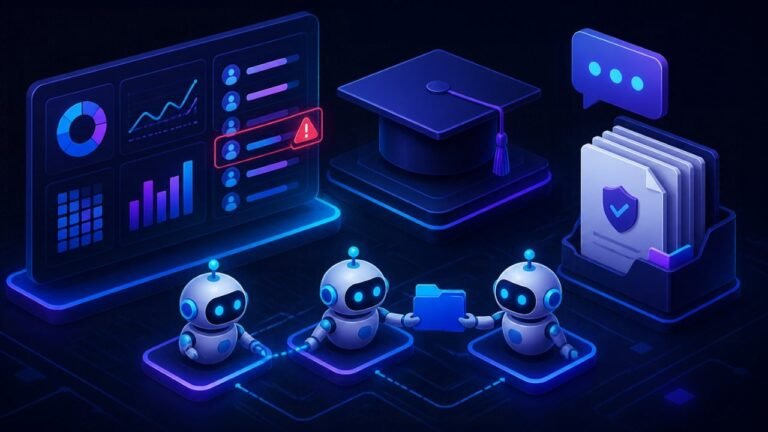
In EduCore AI, an education management platform I built, admissions work is split between three CrewAI agents, each with one narrow job. Instead of one large agent that reads, checks and sorts every application, each agent handles a single stage and hands its output to the next. That made the system much easier to test: when a result looked wrong, it was clear which stage produced it.
The same principle runs through my AI customer support agent. It answers from the company’s own documents, looks up orders through tools, and passes anything it is not confident about to a person with the conversation attached. Neither system is allowed to do more than its job needs.
How to build your first AI agent in five steps
- Pick one task that is repetitive, multi-step and costs someone hours each week, such as qualifying new leads or chasing unanswered quotes.
- Write down how a person does it today: the steps, the tools they open and how they decide what to do next. This becomes the agent’s instructions.
- Connect only the tools it needs, starting with read-only access.
- Run it in draft mode, where it proposes actions and a person approves them, and compare its output with past cases.
- Measure, then widen slowly: track time saved and error rate, and grant more permissions one step at a time.
A focused, single-task agent like this usually takes weeks rather than months to build and test. If you are not sure which task to start with, our AI consulting for small business service begins with exactly that question.
Is your business ready for AI agents?
You are ready when you can describe the task, the tools it needs, what “done” looks like and who checks the result. If your data lives in scattered spreadsheets and inboxes, start by organising it or by building a RAG knowledge base — agents are only as good as the information they can reach. Our AI readiness assessment helps you check.
Frequently asked questions
Are AI agents safe to use with customer data?
They can be, with limited permissions, approved AI providers, audit logs and human approval for sensitive actions. Never give an agent more access than its task requires.
Will AI agents replace my staff?
In small businesses agents mostly remove repetitive work so staff can focus on customers, sales and decisions. Treat them as assistants that need supervision.
What is the difference between an AI agent and an AI assistant?
An assistant mainly responds to your requests in conversation. An agent is given a goal and works through several steps and tools on its own to reach it.
Which tools are AI agents built with?
Commonly a large language model such as Claude or GPT, a framework such as LangGraph or CrewAI, and connections to your apps through APIs.
How long does it take to build an AI agent for a small business?
A single-task agent that runs in draft mode can usually be built and tested in a few weeks. Multi-agent systems and agents that connect to many tools take longer, mostly because of testing and permissions.
Will an AI agent replace my staff?
In a small business, agents work best at taking repetitive steps off people’s plates, such as research, data entry and first drafts, while people keep the decisions and the customer relationships.
Try it free: take the 3-minute AI readiness quiz, see what missed calls cost you with the AI savings calculators, try the in-browser RAG chatbot demo or listen to the AI receptionist demo.
Sources
- U.S. Chamber of Commerce, The Impact of Technology on U.S. Small Business
- Federal Reserve, Monitoring AI Adoption in the U.S. Economy (April 2026)
- Anthropic, Building effective agents
- OWASP Gen AI Security Project, 2025 Top 10 for LLM and Gen AI Apps
- NIST, AI Risk Management Framework
Written by Waseem Hassan, AI/ML engineer and founder of NexaIntellect AI, who builds single and multi-agent systems. See our AI agent development service or book a free consultation.

AI/ML engineer building LLM agents, RAG systems and automation for growing businesses.